The project at Palazzo Gonzaga in Guastalla stemmed from the need to definitively resolve the issue of universal accessibility to the entire monumental complex, while simultaneously addressing the restoration and repurposing of the ducal apartment, located on the main floor and currently used for temporary exhibitions.
The construction of the new elevator, inserted into an existing shaft and designed with compatible and reversible technical solutions, now allows full use of the museum floor, overcoming a historical situation of exclusion. Accessibility is thus addressed as a matter of architectural and urban scale, extending to the entire building, and not limited to individual spaces.
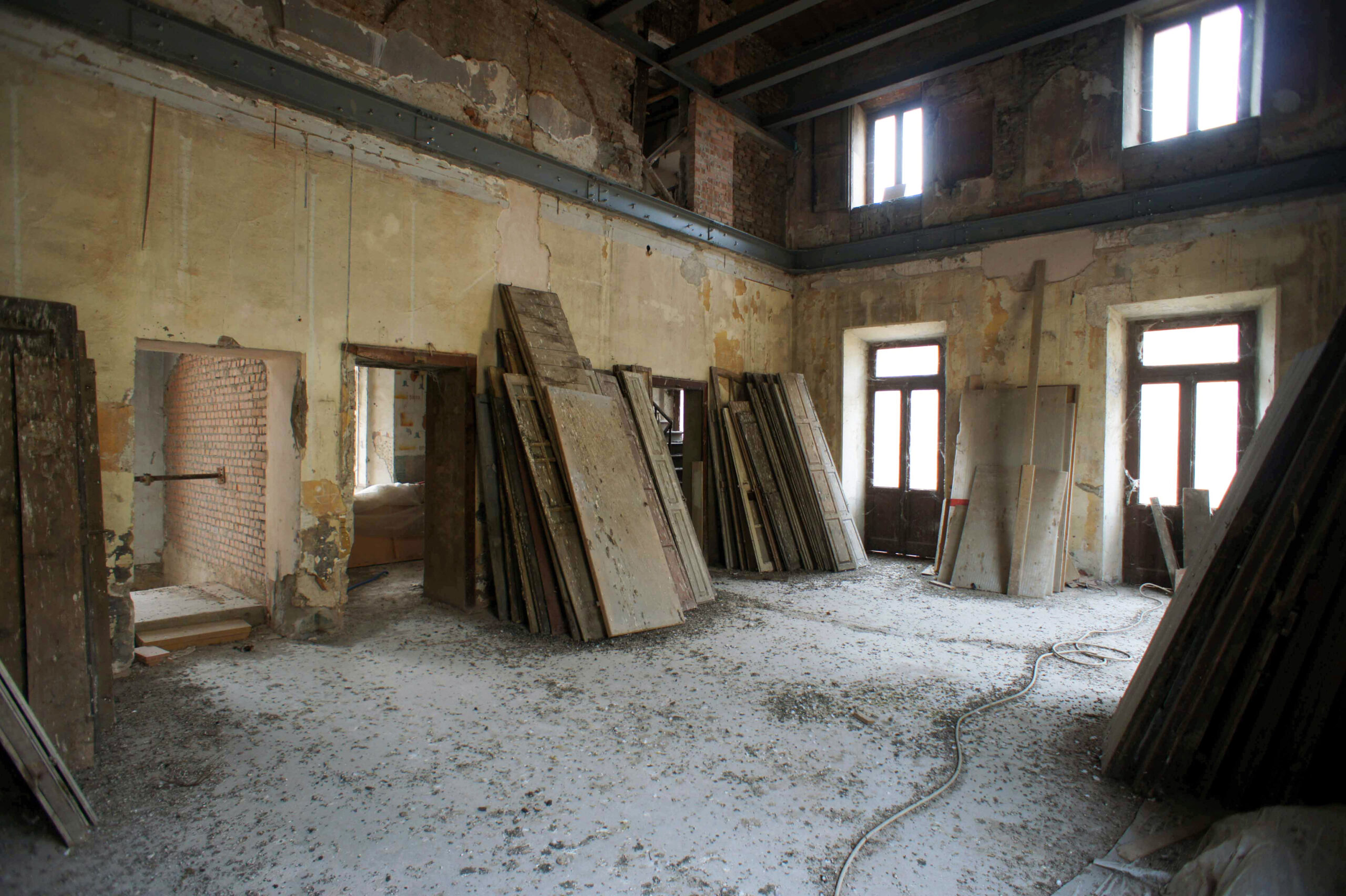
The restoration focused specifically on the wing of the ducal apartment, one of the most complex and layered areas of the palace, profoundly transformed during the 19th and 20th centuries. The loss of valuable historical surfaces, the collapse of the original vaults, the insertion of heavy metal hoops, and spatial fragmentation made any mimetic or reconstructive approach impractical.
Given these conditions, the project took on a decidedly critical and interpretative character. The floating floor, beneath which the utility backbones and air conditioning system were integrated, allowed for a single solution addressing the needs of accessibility, technological adaptation, and protection of the surviving surfaces, minimizing the need for wall recesses and ensuring the project's full reversibility.
Alongside the completed interventions, the project includes a proposal for spatial reconfiguration, yet to be implemented, based on the temporary reconstruction of the ancient pavilion vaults with lunettes using a fabric system tensioned over a freestanding metal structure suspended from the upper structures. This solution, conceived as a lightweight and reversible device, aims to restore an understanding of the original layout of the spaces through the reconstruction of the vaulted surfaces alone, without reproducing the lost wall partitions or introducing elements of historical falsity.
Overall, the project is a contemporary restoration project based on a critical reading of the historical stratification, capable of combining accessibility, conservation, and architectural design without pre-established hierarchies, restoring legibility to a complex and profoundly transformed organism.